Business architecture
Responsibilities, decision rights, and accountability.

FOR GROWING PROPERTY MANAGEMENT COMPANIES
Build the company behind the portfolio.
Book a 20-minute introductory call ↗See how VIRTUA works ↓VIRTUA is an operations partner for growing property management companies. We help owners define how the business should run, establish accountability and performance standards, and build the operating infrastructure and technology that supports execution. We stay involved through clearly scoped operational leadership to measure and improve results.
01 / The owner’s reality
Owners invest in properties, employees and software. But the operating rules that connect them are often left undefined. Renewals depend on memory. Work orders wait without a clear next action. Invoices stall between departments. The owner becomes the default decision maker. Growth makes those weaknesses harder to ignore.
Unclear ownership.
Disconnected departments.
Limited operating visibility.
02 / What you are actually hiring
You are not hiring VIRTUA for another dashboard. You are bringing in an operations partner to understand what is breaking, establish how your company should work, coordinate the systems behind that model, and help leadership manage performance. Software is part of how we deliver; it is not where we start.
Explore the operations partnership ↗03 / The operating architecture
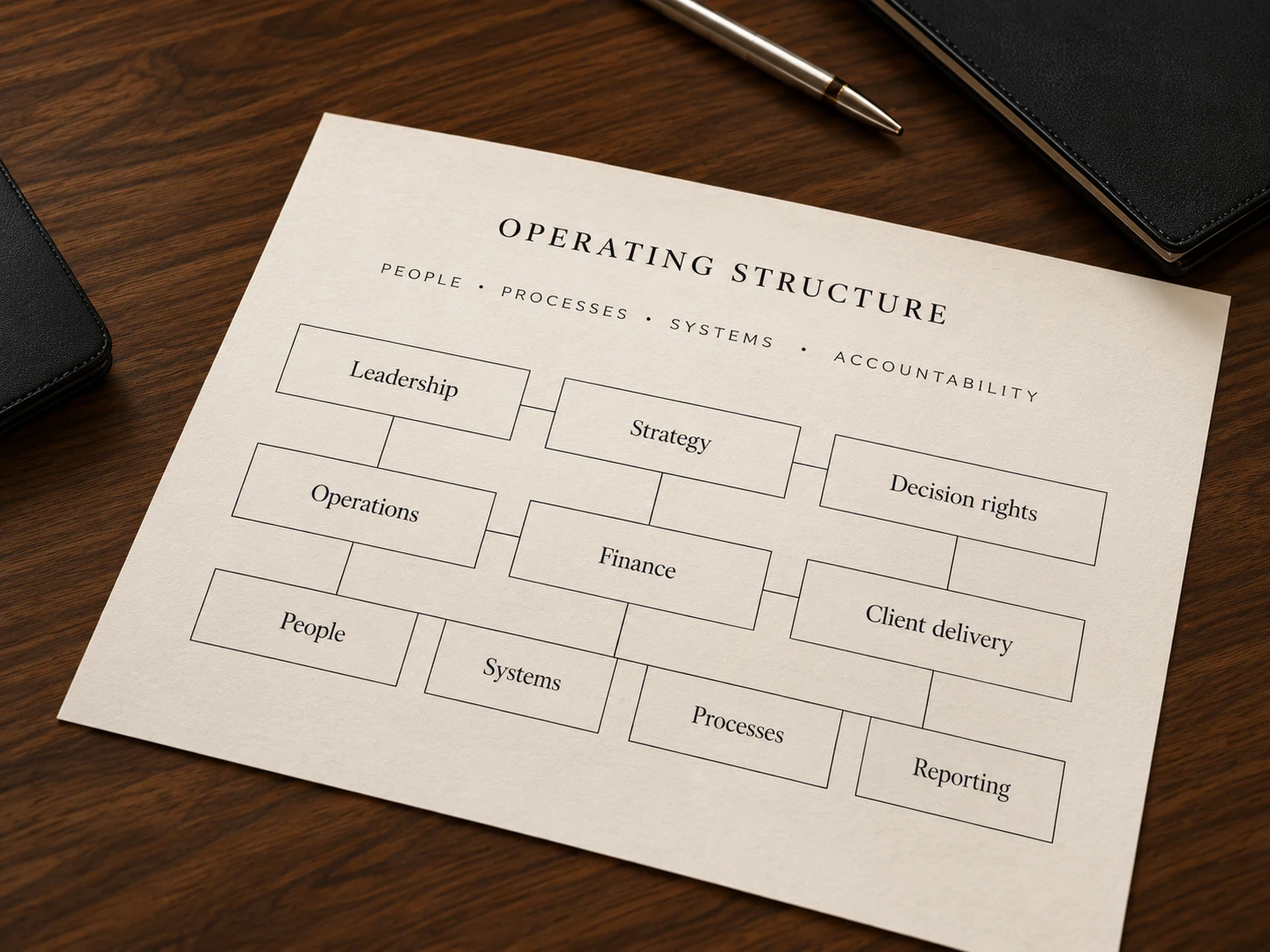
Your existing systems of record can remain effective. We define how responsibilities, decisions and work connect around them. Replacement is recommended only where a defined business need warrants it.
Illustrative operating architecture. Designed around each business.
04 / Company design
We map how work really happens, establish decision rights and service standards, design cross-department handoffs, and build the connected systems that support them. Sometimes that means custom software. Sometimes it means getting more value from the tools you already use.
Responsibilities, decision rights, and accountability.
Software and integrations built around your business.
Agents and automation within approved rules and human authority.
Operating reviews, meaningful reporting, and leadership where contracted.
05 / The method
Operating design comes first. Technology follows the rules, responsibilities and decisions the business needs.
Understand how work moves today and identify the causes of recurring friction.
Define ownership, decision rights, service standards and cross-department handoffs.
Implement the workflows, controls and systems that support the operating model.
Support adoption, review agreed measures and improve within the contracted scope.
06 / Performance measurement
See where work is delayed, why it is delayed, who can act, and whether service standards are being met. Measure renewals, maintenance, approvals, vendor response and follow-through. Separate employee performance from bottlenecks outside an employee’s control.
See how quickly work moves, whether service standards are met, what is blocked by vendors or approvals, and where management attention is needed. Evaluate people fairly by separating controllable execution from external dependencies.
Illustrative measurement categories — agreed around your operation.
Time from a request to a meaningful first response.
Time open, separated by vendor, approval, information or internal execution delays.
Time between a complete decision request and an authorized decision.
Progress against agreed notice dates, decisions and follow-up standards.
Work reopened after completion, reviewed in context to understand why.
Agreed next actions completed by the responsible person within the defined time.
07 / The engagements
Find the root causes and define priorities.
Diagnosis and prioritized roadmap
Design and implement decisions, ownership, workflows, controls and supporting systems.
Implemented infrastructure and adoption plan
Provide a defined management cadence, review performance, improve adoption and evolve the operating model.
Scoped operating leadership and review cadence
Technology Care maintains completed department systems. Fractional COO provides operational leadership. These are separate services, priced independently. Explore investment and services ↗

08 / Founder’s perspective
I kept seeing the same pattern across property management companies: capable people spending their days reacting to problems that should have had a defined process. I saw aging work orders, significant delinquency, decisions waiting on owners, and information scattered across teams. I started building systems because I believed the company itself could operate differently. VIRTUA grew from that conviction: build the operating company behind the assets.
Sonia Treviño · Founder & CEO
For growing property management companies ready to strengthen the business behind the portfolio.
Straight answers
Usually not. We first assess what your current tools already do well, then design the operating rules and connections needed between them. We build custom software only where it solves a defined problem.
VIRTUA is an operating infrastructure and implementation partner. Technology may be part of the engagement, but the work begins with organizational diagnosis and operating design.
Not necessarily. We first define the operating problem and assess the tools you already use. Custom software is appropriate only when a defined need cannot be addressed effectively through your existing systems, operating rules or connections.
We agree on relevant baselines and definitions, such as renewal timeliness, maintenance aging by cause, approval delays, and service follow-through. We review outcomes in context and do not promise a specific result before diagnosis.
AI can assist with classification, drafting, information retrieval and exception visibility when permissions, review rules and escalation controls are defined. It does not replace business judgment.
A scoped operating leadership relationship with agreed review cadence, decision rights, improvement priorities, and implementation support. The exact responsibilities are defined in the engagement.
Yes. We work with the relevant people to understand how the company runs, define responsibilities, test the supporting infrastructure and support adoption. Your team’s knowledge informs the operating design.
Operational Diagnosis & Architecture is $3,500 one-time. Standard department builds are $5,000–$7,000 per department. Technology Care starts at $400/month per completed department, and Fractional COO leadership starts at $5,000/month. These services are priced separately; final scope and terms are defined in the agreement. View investment and services ↗
Start with a conversation about where your company is relying on memory, delayed approvals, scattered tools or recurring escalation. If there is a fit, we begin with an operational diagnosis.
Discuss an operational diagnosis ↗Or email Sonia ↗