If every work order in your operation runs through your phone, you are not managing the property. You are the switchboard — and it is the most expensive role in the building.
Think about how a work order actually moves through your operation right now.
The tenant calls you. You guess the priority. You text the super. You email the owner. You make a note to update the tracker, and then a more urgent fire pulls you away before you do. Two days later the tenant calls back, annoyed, asking what is happening — and you have to reconstruct the whole thing from memory, because the only place that work order ever lived was in your head and a string of text messages.
That is not property management. That is being a switchboard. Every request routes through one person, by hand, in real time. And the moment that person is unavailable, the operation stops.
Why the switchboard is so expensive
The cost is not the minutes spent on any single call. It is what those minutes crowd out, and what they hide.
They crowd out the work only you can do. Owner relationships, problem units, the judgment calls that actually move the business — those get squeezed into the gaps between routing requests you should never have been touching.
They hide the dropped balls. When the system of record is a person’s memory, there is no list of what is open, no age on any request, no way to see what slipped. You only find out about the work order nobody handled when the tenant escalates — or when the owner does.
And here is the part that makes it dangerous: it scales the wrong way. Every new unit, every new property, adds load to the same single switchboard. You do not grow out of it. You drown in it.
Your PMS won’t fix this
It is tempting to assume the software should handle routing. It does not. AppFolio, Buildium, Yardi — they will store the work order beautifully once it is closed. What they do not do is take the inbound request, assign it to the right vendor, notify the tenant, escalate it when it ages, and give the owner a clean summary without you in the middle of every step.
That is the operational work — the routing, the chasing, the updating — and it lives in the gap your system of record leaves open. By default, you are the thing filling that gap.
What replaces the switchboard
One routing system, built once, that runs the path on its own:
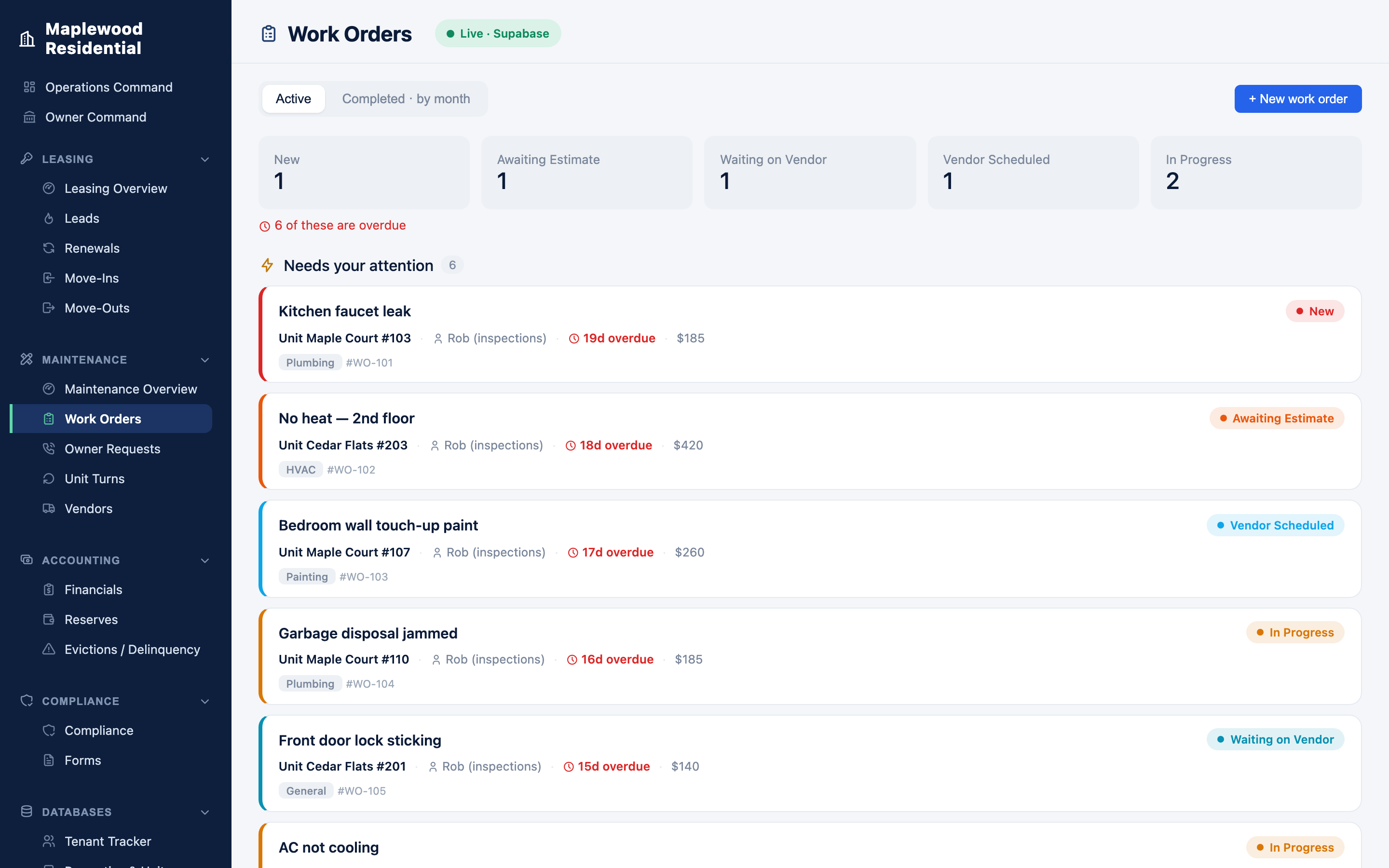
Intake captures itself. A request comes in — from a call, a form, an email — and lands in one place as a real work order, with a number, a unit, and a status. Not a text message.
It routes to the right vendor automatically based on the type of issue, with the details they need to act — no game of telephone.
The tenant gets updated without you. Acknowledged, assigned, scheduled, resolved — the status moves and the tenant sees it, so they stop calling you to ask.
It escalates on age, not on memory. A request open past your threshold surfaces on its own, so nothing quietly sits for two weeks.
The owner gets a clean summary automatically. No more reconstructing the month from your sent folder.
For one of our clients — a thirty-tenant commercial operator — building this routing once gave back roughly two hundred hours a year. But the hours were not even the point. The point was that the founder stopped being the person every request waited on.
The switchboard was never your job
It was a missing system. The reason you became the switchboard is not that you are bad at delegating — it is that there was no structure to route the work to, so it routed to the only reliable thing available: you.
Build the structure, and the role disappears. The work still gets done — faster, and visibly — and you get back the hours for the work that actually needs you.