A single lease renewal takes about two hours — and it happens fifty times a month. It’s the most automatable workflow in property management. Here’s how to rebuild it.
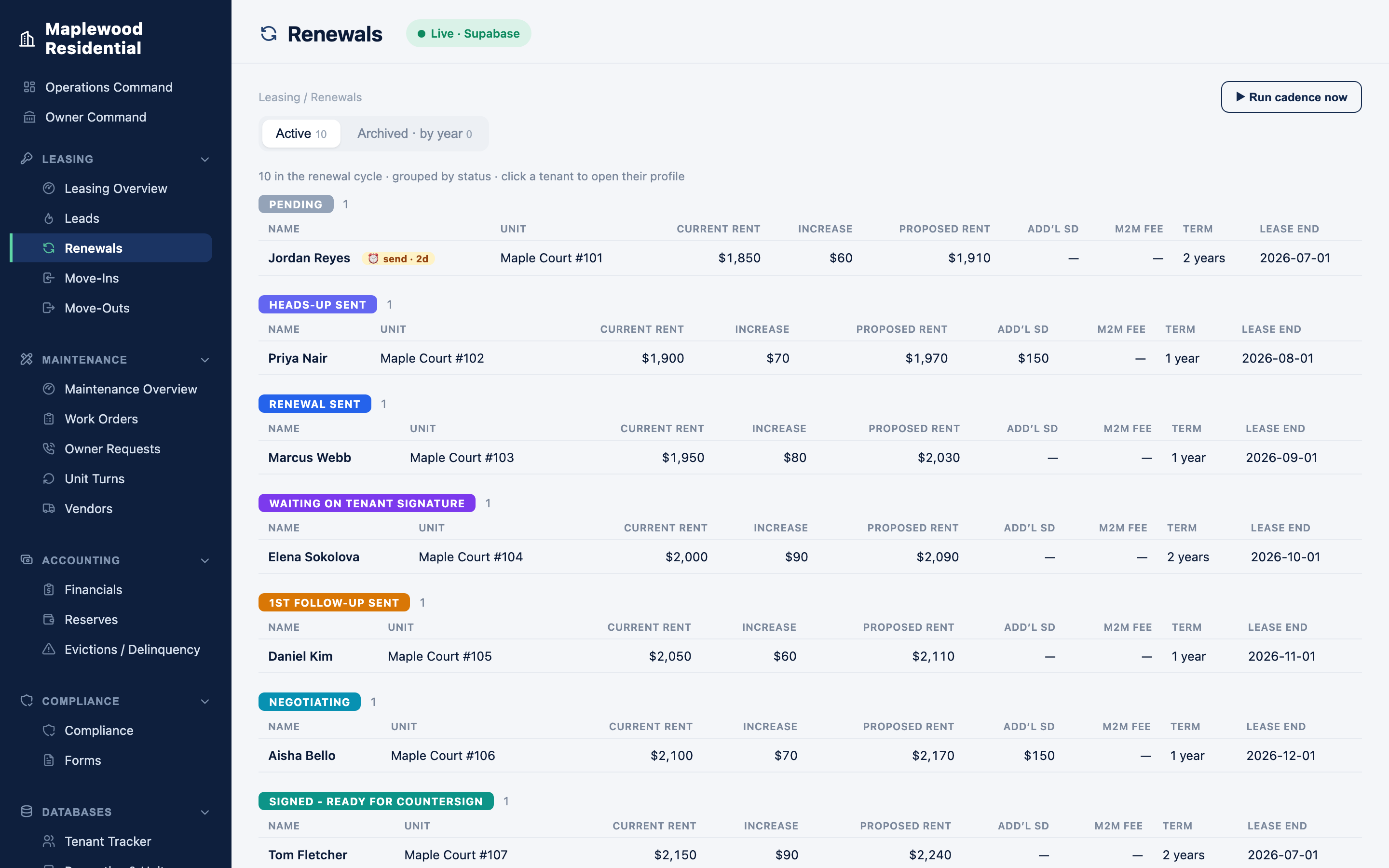
If you want to see exactly where a property operation loses its time, watch one lease renewal go through, start to finish. It is not dramatic. It is not a crisis. It is two quiet hours of a skilled person doing work that software should have done — and it happens fifty times a month.
That makes the renewal the single best place to start automating. Here is the workflow, the way it runs today, and how to rebuild it.
The renewal, the way it runs today
Strip a renewal down and it is roughly seven steps: pull the list of expiring leases, draft the renewal letter by hand, email every tenant on the unit, chase the signature — then chase it again, route the owner’s countersignature, file the signed document, and re-key the new rent into the PMS.
Every one of those steps is a place a person is required, and every handoff between them is a place something can stall. Multiply by fifty a month and you are not looking at a task. You are looking at a job nobody was hired for.
Rebuilding it, step by step
Each of those seven steps maps to something a system can do.
Pulling expiring leases becomes a trigger. The system watches lease end dates and starts the workflow on its own — no one has to remember.
Drafting becomes generation. The renewal letter is a template with the unit, the tenant, the new rent and the term filled in from data the system already holds.
Sending becomes one action. One envelope goes to every lease-holder on the unit at once, not a separate email per person.
Following up becomes a cadence. The system chases the signature on a schedule, and only escalates to a person when it actually needs one.
Countersignature becomes routing. Once the tenant signs, it goes to the owner automatically.
Filing becomes automatic. The executed PDF lands where it belongs without anyone dragging a file.
Re-keying disappears. The new rent and term write straight back into your PMS, so your system of record stays accurate without a person re-typing anything.
The compliance layer
There is one more step that should never be left to memory: the rent cap. In a rent-regulated market, every increase has a legal ceiling. A system checks the cap before anything ships — so a renewal letter cannot go out with a number that exposes the owner. Compliance stops being something you hope someone remembered, and becomes something the workflow enforces.
Two hours becomes two clicks
Rebuilt, the renewal looks like this from the property manager’s side: enter the new rent and term, click send. That is it. The system writes the letter, sends the envelope, runs the follow-ups, routes the countersignature, files the document, updates the record, and checks the cap.
Two hours of skilled time becomes about two clicks. Fifty times a month, that is most of a salary handed back to higher-value work.
The same pattern, everywhere
The renewal is the clearest example, but it is not special. Work-order intake, the delinquency cadence, the move-out checklist, inspection scheduling — every repeatable workflow in property management follows the same shape: a trigger, a sequence, a definition of done. Rebuild one and you have the pattern for all of them. That is what an operating system is — the renewal workflow, applied to the whole operation.