Most “automation” in property management automates a single task and calls it a system. Here’s the difference between busywork with extra steps — and an operation that runs itself.
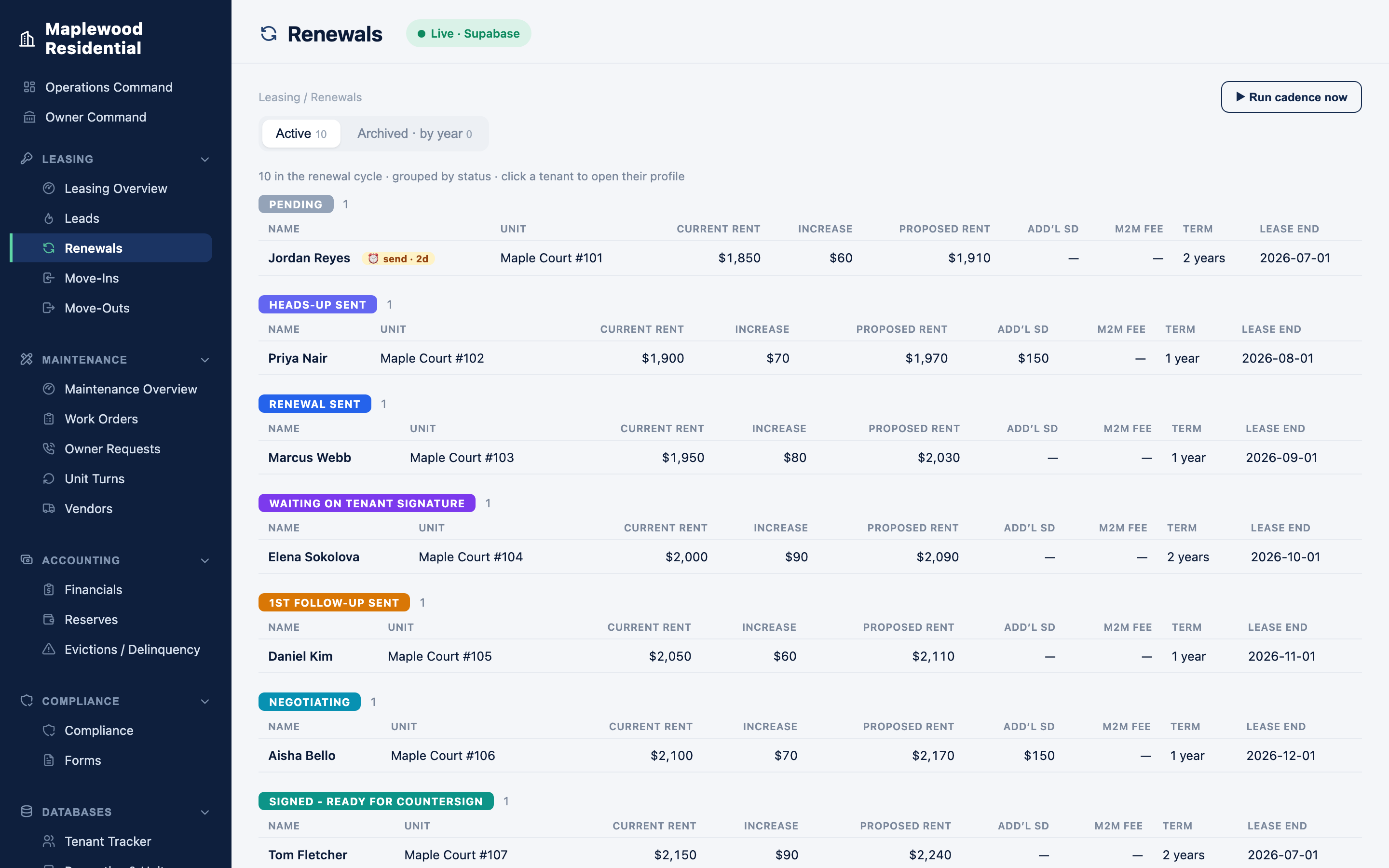
“Automation” is the most overused word in property management software. Every platform promises it. Most of what gets sold under that name is a single shortcut bolted onto a process that is still, underneath, manual. A template here. An auto-reminder there. The renewal letter still gets written by a person, sent by a person, chased by a person.
Real automation is not a feature you switch on. It is a property of a system. The gap between those two ideas is where most property operations quietly lose their time.
Why most automation fails
Two reasons, and they compound.
The first: it automates a task instead of a workflow. A lease renewal is not one task — it is seven or eight, strung across email, a PDF, a signature tool and the PMS. Automating step three while the rest stay manual does not remove the work. It moves it around. The person is still the engine; they just press one fewer button.
The second, deeper reason: your property management software was never built to do the work. Yardi, AppFolio, Buildium — they are systems of record. They store the lease, the ledger, the tenant. They are excellent filing cabinets. But a filing cabinet records what already happened. It does not pull the list of expiring leases, draft the letter, send it, follow up and re-key the new rent. Someone does that, then tells the software about it afterward.
So “turn on automation” inside a system of record mostly means “turn on reminders.” And the reminder still points at a human.
What actually works
Automation that holds up has four things in common.
It runs the whole workflow, end to end. Not just the draft — the draft, the send, the follow-up, the countersignature routing, the filing, the record update. If a person has to carry the workflow between steps, it is not automated. It is assisted.
It keeps your PMS as the system of record. You do not rip out Yardi. The automation layer sits on top, does the work, and writes the result back so your source of truth stays accurate. One place for the data, one place for the action.
It is one system, not seven. Every tool you add is another login, another export, another place data goes to disagree with itself. Real automation consolidates. The fewer seams, the fewer places work falls through.
It leaves the human work to humans. Showings, hard tenant conversations, judgment calls on a problem unit — those should never be automated. The point of removing the paperwork is to give your team back the hours for the work that genuinely needs a person.
The test for what to automate
Here is the whole rule: if a task happens the same way every time, software should do it — not your team.
Lease renewals happen the same way every time. Work-order intake happens the same way every time. The late-notice cadence, the compliance deadlines, the move-out checklist — same way, every time. That is not work that needs a person. That is work that needs a system.
The tasks that vary — the ones that need a decision — are exactly the ones to protect. Automate the repeatable so your people have room for the rest.
Where to start
You do not start by buying another tool. You start by mapping what your operation actually does today — every workflow, every manual step, every place a person is acting as glue between two pieces of software. Once you can see the repeatable work, you can see what a system would remove. That map is the beginning of an operating system.