Most growing property operations don’t run on software — they run on a dozen disconnected spreadsheets and one person’s memory. Here’s the real problem, and how to fix it without buying a 13th tool.
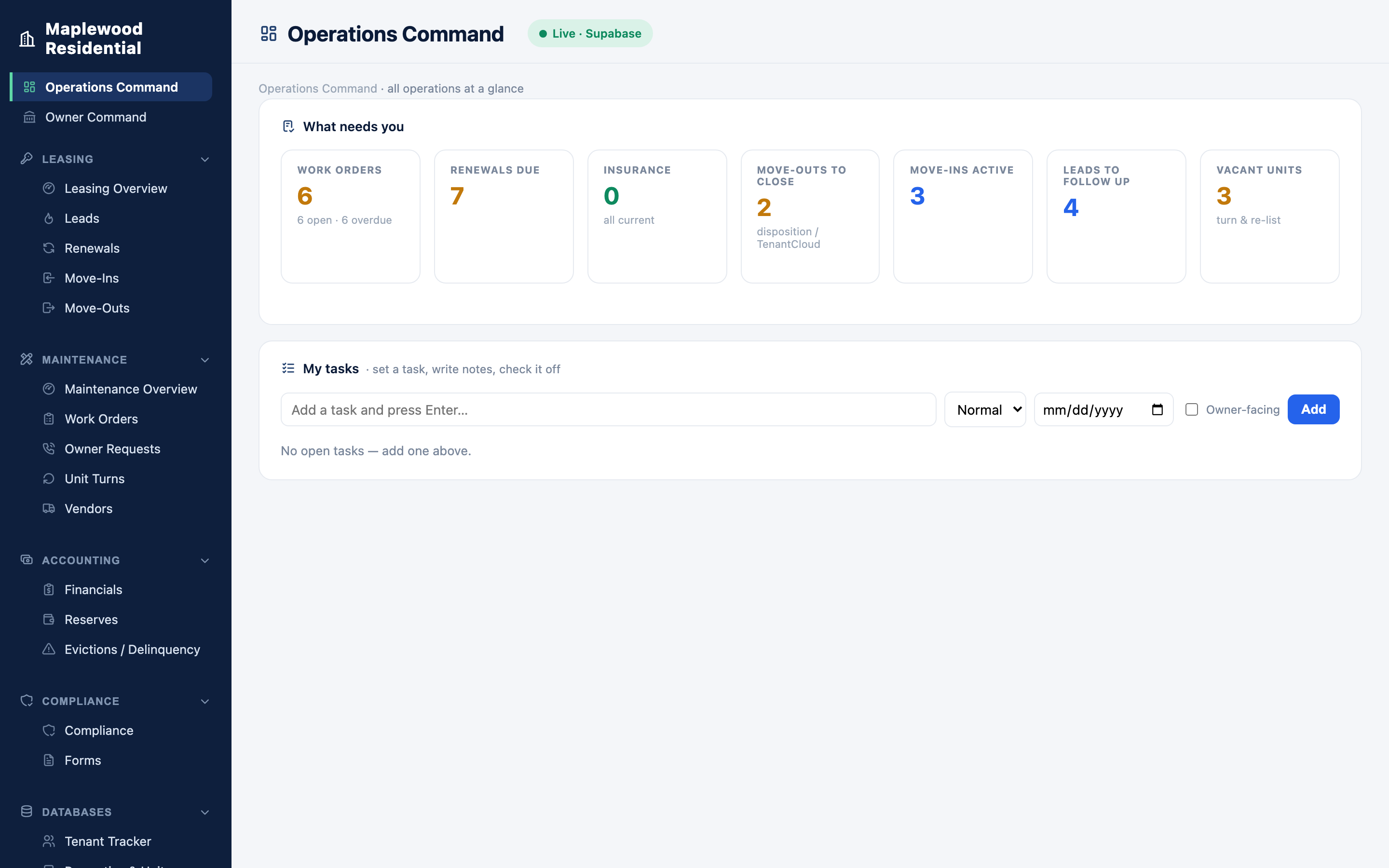
Most 200-unit operations don’t run on software. They run on twelve spreadsheets and one person’s memory.
Walk into almost any growing property company and you’ll find the same thing. There’s a rent roll. A renewals tracker. A work-order log. A delinquency sheet. A move-out pipeline. A vendor list. An owner-reporting workbook. A lead tracker. Each one is reasonable on its own. Together they’re the actual operating system of the business — and nobody designed it.
Twelve tabs, zero connections
Here’s the part that costs you. None of the twelve talk to each other.
The renewal that gets signed in one sheet doesn’t update the rent roll in another. The move-out flagged in a third doesn’t start the turn in a fourth. So the “system” that holds it all together isn’t software at all — it’s whoever keeps the twelve in sync by hand, re-typing the same date and the same dollar amount into three places that still manage to disagree.
That person is the single point of failure. They take a week off and the operation goes dark — not because they’re irreplaceable, but because the knowledge of how the twelve fit together lives only in their head. (If that sounds familiar, it’s the same trap we wrote about in You’re Not the Manager, You’re the Switchboard.)
Why the spreadsheets aren’t even the problem
It’s easy to blame the spreadsheets. But studies put input errors in 88% of all spreadsheets — and the real cost isn’t the typos. It’s the 100+ hours a year spent re-keying data between tabs, the late-payment follow-ups that slip, and the owner reports built from numbers that don’t match.
The problem was never that you have twelve spreadsheets. Plenty of good operations are built on spreadsheets. The problem is that nothing connects them, so a human has to be the connection — all day, every day, forever.
Why a 13th tool usually makes it worse
The instinct is to buy software. But a thirteenth tool is a thirteenth tab — another login, another export, another place the data goes to disagree with itself. More tools don’t connect the operation. They add seams, and work falls through seams. A new platform replaces tools you trust with one you don’t, and you still end up with a person re-keying between it and everything it didn’t replace.
The fix: connect, don’t replace
You don’t need to throw the twelve sheets away. You need one layer sitting on top of them that does the connecting automatically — what we call a property management operating system.
When a renewal is signed, the rent roll updates itself. When a tenant gives notice, the move-out pipeline and the turn checklist start on their own. When a work order comes in, it routes, updates the tenant, and logs itself — no re-keying. The data gets entered once and pulled from one place, and the owner report builds itself from numbers that finally agree.
We’ve done exactly this for operations running 600+ units. We didn’t sell them a new platform. We connected what they already had into one live operation — and the hours that used to go into keeping twelve tabs in sync went back to the team.
The two-week test
Ask yourself one question: if the person who keeps your spreadsheets in sync took two weeks off, what would break? If the honest answer is “most of it,” you don’t have a software problem. You have a connection problem — and that’s fixable without burning down the tools you already trust.